
A clunk over bumps, a car that drifts or a steering wheel with play in it all start in the same set of parts under the car. This page explains how those parts wear, what the shop checks and the questions worth raising before you approve the work.
The suspension holds each wheel against the road and soaks up bumps, and the steering turns the front wheels when you turn the wheel. Both rely on joints and rubber pieces that wear so gradually that a car can feel normal to its owner long after a mechanic would call it worn.
Front-end estimates often list several parts at once, with an alignment at the end. Knowing what each part does, and why some are replaced in pairs, helps you tell a complete repair from a padded one and gives you the right questions for the service writer.
What you might notice
- A clunk or knock from a front corner over bumps
- On a straight, level road the car wanders toward one side
- Play in the steering wheel before the car starts to turn
- The nose dips hard when you brake or keeps bobbing after dips
- Steering that groans or turns heavy at parking speeds
- Wear on the inside or outside edge of a tire
How the parts work and wear
Shocks and struts control how the springs move, so the body comes to rest after a bump instead of bobbing. Control arms hold each wheel in place and pivot on rubber bushings, while ball joints let the wheels steer and travel up and down. Tie rods connect the steering rack to the wheels and set the angle they point at.
Shocks and struts lose their damping slowly, bushings crack and soften, and ball joints and tie rod ends develop play once their grease and rubber covers fail. Power steering, run by fluid or by an electric motor, adds the help you feel at low speed. Wear in any of these parts changes how the tires meet the road.
- Shocks and struts settle the car after bumps
- Ball joints and tie rods carry the steering
- Bushings cushion each pivot point
What the shop checks
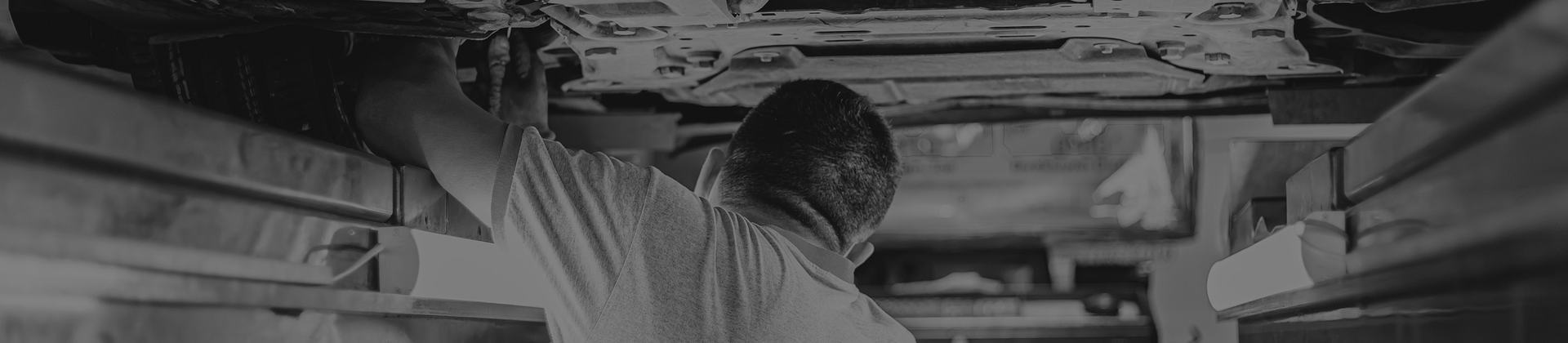
The mechanic usually starts with a road test over rough pavement and a few slow turns, listening for where the noise comes from. With the car raised, they rock each wheel by hand and pry at the joints to feel for play, and look for torn rubber boots, cracked bushings and oil weeping from a shock.
They also check the power steering fluid or the electric system's fault codes, and read the tire wear, which often shows which part has been out of place. Any job that disturbs the steering or suspension is followed by an alignment, because new parts shift the wheel angles even when everything is fitted correctly.
- A road test to place the noise
- Wheels rocked by hand to find play
- Tire wear read for clues about the cause
What drives the cost
Struts come as bare struts or as complete assemblies with the spring and mount already fitted, and the assembly usually takes less labor to install. Parts quality varies widely, so ask whether the estimate lists original equipment or an aftermarket part, and what warranty each one carries.
Shocks and struts are normally replaced in pairs on the same axle, so the car handles evenly side to side, and an alignment follows most front-end work. Replacing a worn joint early keeps it from chewing up the tires or the parts around it, which is the extra a late repair often brings.
- Bare strut or complete assembly with spring
- Pairs on the same axle for even handling
- The alignment afterward as its own line item
What needs checking before you drive on
Steering is a safety system, so looseness, a sudden pull, a wheel that feels wobbly or a loud clunk when turning means get it checked soon, and stop somewhere safe if it gets worse on the road. A badly worn ball joint or tie rod can come apart, and the wheel then no longer steers.
Softer damping or a shock that weeps oil changes how the car stops and corners, so have it looked at soon rather than leaving it for the next service. The mechanic who has had the car on a lift decides how urgent it is, and you can ask them to write that timing on the work order.
- A wobbly wheel or loose steering: stop safely
- A new pull or heavy steering: get it checked soon
- Ask for the timing in writing on the work order
Questions to ask the shop
- Which parts have play, and can you show me on the lift?
- Is the strut a bare unit or a complete assembly?
- Are you replacing both sides on the axle, and why?
- Is the alignment included, and will I get the before and after printout?
- Which of these parts are urgent, and which can go on a later visit?
Between visits
- Keep tire pressures where the door jamb label says
- Note which corner a noise comes from and when it happens
- Slow right down for potholes, curbs and speed bumps
- Look at the tire edges for uneven wear when you wash the car
- Keep the alignment printout with the repair receipt in your folder
Questions about suspension and steering
Replacing struts, control arms or tie rods moves the points that set the wheel angles. Even a careful install leaves them slightly off, and the tires then wear unevenly. The alignment brings the angles back to the carmaker's specification.
They are usually replaced on both sides of the same axle so the car responds evenly when it brakes and turns. A new strut on one side and a tired one on the other can make the car lean or pull. Ask the shop to explain if it suggests only one.
It means the wheel moves before the front tires respond, which often points to wear in the tie rod ends, the ball joints or the steering rack. Only a mechanic who has checked the car can say which. Have it checked soon, because steering looseness tends to grow.